
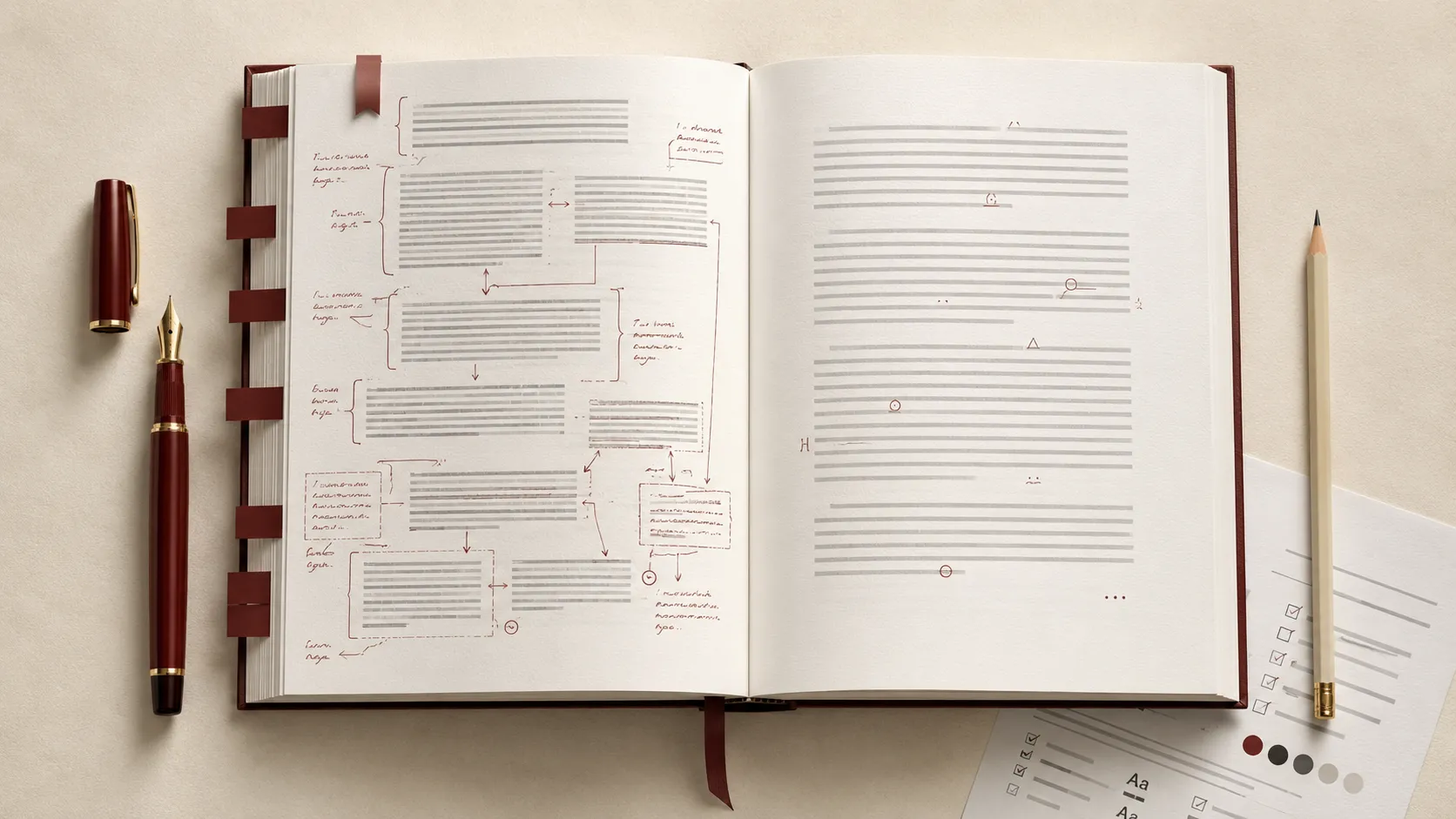
Finishing a manuscript is a major achievement, but completing the first draft does not necessarily mean the book is ready to publish. Even experienced authors need an objective editorial process to identify structural problems, unclear passages, inconsistencies, awkward sentences, and small errors that are easy to miss after working on the same manuscript for months.
This is where book editing and proofreading become important.
Authors often use the words “editing” and “proofreading” as though they describe the same service. While both improve the quality of a manuscript, they focus on different problems and normally happen at different stages of the publishing process.
Editing may reshape the structure, content, clarity, voice, and sentence-level quality of a book. Proofreading is the final quality check performed after the major writing, editing, and layout decisions have already been completed. The Chartered Institute of Editing and Proofreading describes proofreading as the final check of the words and layout before publication.
Understanding this difference can help you choose the right service, avoid paying for the wrong type of review, and publish a book that feels professional from the first page to the last.
What Is Book Editing?
Book editing is a broad term that can include several levels of manuscript improvement.
Depending on the condition of the manuscript, an editor may examine the overall structure, chapter order, pacing, character development, clarity, tone, sentence flow, grammar, consistency, and factual completeness.
Editors Canada separates professional editing into different levels, including structural editing, stylistic editing, copyediting, and proofreading. Structural editing focuses on the organization and content of the material, while stylistic editing improves meaning, coherence, flow, and language at the paragraph and sentence level.
Book editing may therefore involve major recommendations or detailed sentence-level corrections. The exact service depends on what the manuscript needs.
A professional editor does not simply search for spelling mistakes. The editor helps strengthen the reading experience while preserving the author’s message and voice.
What Is Proofreading?
Proofreading is the final review performed when the manuscript has already been written, edited, and usually formatted.
At this stage, the book should not require major restructuring, extensive rewriting, new chapters, or large changes to the author’s argument. The proofreader works with a nearly finished version and looks for remaining errors that may have survived earlier stages.
Proofreading may identify:
- Spelling mistakes
- Typographical errors
- Missing or repeated words
- Incorrect punctuation
- Inconsistent capitalization
- Incorrect page numbers
- Header and footer problems
- Uneven spacing
- Formatting inconsistencies
- Incorrect chapter headings
- Broken line or page breaks
- Small errors introduced during layout
Proofreading is intentionally narrower than developmental editing, line editing, or copyediting. Large revisions made during proofreading can create new errors, affect page layout, and require additional quality checks.
This is why proofreading should usually happen near the end of the publishing process rather than immediately after the first draft.
The Main Difference Between Editing and Proofreading
The easiest way to understand the difference is to think about the questions each professional asks.
An editor may ask:
- Does the book make sense?
- Is the structure effective?
- Are the chapters in the correct order?
- Is the argument complete?
- Is the story engaging?
- Is the tone suitable for the audience?
- Are the sentences clear?
- Are important details missing?
- Does the manuscript maintain a consistent voice?
A proofreader may ask:
- Is this word spelled correctly?
- Is the punctuation accurate?
- Is the heading formatted consistently?
- Is a word missing?
- Is the page number correct?
- Was an error introduced during formatting?
- Are the final files clean enough to publish?
Editing improves the substance and expression of the manuscript. Proofreading checks the final presentation.
Both services are important, but they cannot always replace one another.
The Different Types of Book Editing
Before hiring an editor, authors should understand the main editing levels. The terminology may vary between agencies and individual editors, so the scope should always be confirmed before purchasing a service.
Developmental Editing
Developmental editing examines the manuscript as a complete work.
It focuses on the large elements of the book rather than individual commas and spelling errors. The editor evaluates whether the content is organized effectively and whether the book fulfills its intended purpose.
For a nonfiction book, developmental editing may examine:
- The central promise of the book
- The needs of the target reader
- The strength of the argument
- Chapter organization
- Repetition
- Missing explanations
- Examples and supporting evidence
- Transitions between topics
- The balance of theory and practical advice
- Whether the conclusion delivers a satisfying result
For fiction, developmental editing may examine:
- Plot structure
- Character development
- Motivation
- Conflict
- Pacing
- Point of view
- World-building
- Dialogue
- Story continuity
- The effectiveness of the ending
Editors Canada defines structural editing as assessing and shaping the overall organization and content for the intended audience, medium, and purpose.
Developmental editing is often the right starting point when a manuscript contains strong ideas but still feels disorganized, repetitive, incomplete, or difficult to follow.
Line Editing
Line editing focuses on how the manuscript communicates at the sentence and paragraph level.
A line editor may improve:
- Sentence rhythm
- Word choice
- Clarity
- Tone
- Transitions
- Paragraph flow
- Repetition
- Awkward phrasing
- Unnecessary words
- Emotional impact
- Authorial voice
The purpose is not to make every author sound the same. A good line editor strengthens the writing while protecting the author’s personality.
Editors Canada describes stylistic editing as work that clarifies meaning, maintains coherence and flow, refines language, and helps maintain the appropriate tone and level for the intended audience.
Line editing can be particularly valuable for authors who know what they want to say but need help making the writing feel natural, engaging, and professional.
Copyediting
Copyediting focuses more closely on correctness, consistency, and readability.
A copyeditor may review:
- Grammar
- Punctuation
- Spelling
- Usage
- Capitalization
- Hyphenation
- Number formatting
- Dates
- Names
- Terminology
- Internal consistency
- References
- Basic factual inconsistencies
- Style-guide compliance
Editors Canada defines copyediting as reviewing material for correct and consistent grammar, punctuation, spelling, and usage, while also checking that required content elements are accurate and complete.
A copyeditor may also prepare a style sheet. This document records editorial decisions such as preferred spelling, capitalization, character details, punctuation choices, terminology, and other consistency rules. Style sheets can be especially useful for long manuscripts, book series, fiction, technical books, and projects involving multiple editors.
Proofreading
Proofreading occurs after the manuscript has gone through the required editing and formatting stages.
The proofreader checks the final pages or files for remaining mistakes. The goal is not to reconsider the entire book strategy. It is to catch errors before readers, reviewers, or customers see them.
A proofreader may compare:
- Chapter title styles
- Page numbers
- Table of contents entries
- Font usage
- Paragraph spacing
- Headers and footers
- Italics and bold text
- Image captions
- Lists and tables
- Scene-break symbols
- Print margins
- Final punctuation and spelling
Amazon KDP also allows authors to order proof copies of print books so they can review a physical test copy before publication.
This physical review can reveal issues that are easy to miss on a computer screen, including narrow margins, small text, unexpected blank pages, image-quality problems, and incorrect cover alignment.
Do Authors Need Both Editing and Proofreading?
In most cases, yes.
Editing and proofreading solve different problems. A manuscript may have perfect spelling but still contain weak organization, unclear arguments, repetitive chapters, or inconsistent characters. It may also have excellent content but look unprofessional because of typographical and layout errors.
Editing improves the manuscript before final formatting. Proofreading checks the final result after editing and layout.
A typical professional workflow may look like this:
- Manuscript assessment or developmental editing
- Author revisions
- Line editing or stylistic editing
- Copyediting
- Final author review
- Ebook and print formatting
- Proofreading
- Final corrections
- Publishing submission
Not every book needs every stage at the same depth. A short business book based on an approved outline may require less developmental work than a complex memoir or novel. However, moving directly from an early draft to proofreading is rarely enough when the manuscript still has content or structural problems.
Why Proofreading Cannot Replace Editing
Some authors choose proofreading because it appears faster or less expensive than a full edit. This can create disappointing results.
A proofreader may correct the spelling in a confusing chapter, but the chapter will still be confusing. They may correct punctuation in repetitive paragraphs, but the repetition will remain. They may fix a character’s name on one page without addressing a weak plot or inconsistent motivation.
Proofreading is not designed to solve:
- Weak structure
- Missing chapters
- Poor character development
- Unclear arguments
- Repetitive content
- Unconvincing examples
- Inconsistent voice
- Major pacing issues
- Large factual gaps
- Extensive rewriting needs
If a manuscript requires these changes, editing should happen first.
Trying to make major content revisions during the proofreading stage can also disturb the final layout. Adding or removing paragraphs may change page numbers, headings, the table of contents, image positions, and print-cover spine width.
Why Editing Cannot Completely Replace Proofreading
Even a carefully edited manuscript can develop new errors during later stages.
Formatting may introduce:
- Incorrect page breaks
- Missing italics
- Repeated headings
- Broken lists
- Incorrect indentation
- Inconsistent spacing
- Isolated lines
- Table of contents errors
- Font changes
- Missing images
- Incorrect page numbers
The editor may also overlook minor mistakes while focusing on larger concerns such as structure, clarity, and flow.
Proofreading provides one final opportunity to review the book as a finished product rather than as a working manuscript.
How to Know Which Service Your Manuscript Needs
The condition of your manuscript should guide your decision.
You May Need Developmental Editing If:
- You are unsure whether the book is well organized.
- Chapters feel repetitive or disconnected.
- The beginning is slow.
- The ending feels incomplete.
- Your argument needs stronger support.
- Characters or plotlines are underdeveloped.
- You are not sure what should be removed or added.
- Early readers do not understand the book’s main purpose.
You May Need Line Editing If:
- The ideas are strong, but the writing feels awkward.
- Sentences are too long or repetitive.
- The voice changes between chapters.
- The tone does not suit the target audience.
- The manuscript feels flat or overly formal.
- Transitions need improvement.
- You want the prose to feel more engaging.
You May Need Copyediting If:
- The structure is already stable.
- You need grammar and punctuation corrections.
- Spelling and capitalization are inconsistent.
- Names, terminology, and dates need checking.
- The manuscript needs a professional style sheet.
- You want a clean version before formatting.
You May Need Proofreading If:
- The manuscript has already been fully edited.
- The content is final.
- The book has been formatted.
- You are preparing to publish or print.
- You need a final check for minor errors and layout problems.
If you are still unsure, request a manuscript assessment or professional sample review before selecting a service.
When Should Editing Begin?
Editing should begin after the author has completed the strongest self-revised draft they can produce.
Before submitting a manuscript to an editor:
- Finish the complete draft.
- Read it from beginning to end.
- Remove obvious repetition.
- Resolve incomplete sections.
- Check the chapter order.
- Confirm important names and facts.
- Apply feedback from trusted early readers where useful.
- Clearly identify the intended audience.
Submitting an extremely rough or incomplete draft may increase the amount of editorial work required.
However, authors should not spend years trying to make the manuscript perfect before seeking help. A developmental editor can often identify problems the author cannot see because they are too close to the work.
When Should Proofreading Begin?
Proofreading should begin only after the text is considered final and the book has been formatted in its intended layout.
For ebooks, the proofreader may review the final EPUB and test how the content appears across reading applications or devices.
For print books, the proofreader may review the print-ready PDF and, where possible, a physical proof copy.
Avoid making unnecessary creative changes after proofreading begins. Every new change creates another opportunity for mistakes.
What Should Authors Expect From a Professional Editor?
A professional editor should provide a clear explanation of:
- The editing level being offered
- What will and will not be reviewed
- The expected delivery time
- The file format
- Whether tracked changes will be used
- Whether an editorial report is included
- How questions will be handled
- Whether fact-checking is included
- How revisions or follow-up support work
- The total price
The editor should also respect the author’s voice.
Editing should strengthen the manuscript rather than erase its personality. The author should remain responsible for final decisions and should have the opportunity to accept, reject, or discuss significant editorial changes.
Book Creation Experts provides book editing and proofreading as part of its wider manuscript and publishing services. You can review the available ghostwriting, editing, and publishing services to understand how editorial support can fit into the complete book-production process.
Common Editing and Proofreading Mistakes Authors Make
Hiring Only on Price
The lowest quote may not include the level of editing the manuscript actually needs. Compare the scope, experience, communication process, and included services rather than price alone.
Asking for Proofreading Too Early
If the manuscript still needs major rewriting, proofreading will not solve the central problems.
Skipping the Final Proof
Publishing immediately after copyediting can allow layout and formatting errors to reach readers.
Assuming Software Is Enough
Grammar and spelling tools can identify some surface-level issues, but they do not fully understand context, voice, argument quality, plot logic, reader expectations, or book structure.
Ignoring the Editor’s Scope
An editor hired for copyediting may not provide developmental feedback unless it was included in the agreement.
Sending Constantly Changing Files
Editing becomes difficult when the author continues rewriting different versions at the same time. Establish one master manuscript and follow a clear version-control process.
Failing to Review Changes
Authors should not accept every change automatically. Review the edited manuscript carefully and ask questions where needed.
How Much Do Editing and Proofreading Cost?
Pricing depends on several factors, including:
- Word count
- Manuscript condition
- Genre
- Editing level
- Technical complexity
- Research requirements
- Delivery timeline
- Formatting condition
- Experience of the editor
- Additional services
Developmental editing is generally more extensive than proofreading because it requires deeper analysis of the complete manuscript. Line editing and copyediting also require more intervention than a final proof check.
When comparing prices, ask whether the package includes multiple editorial stages, formatting, cover design, publishing assistance, or revisions.
You can review the available book creation pricing plans to compare packages that combine writing, editorial, design, formatting, audiobook, website, and publishing support.
Final Thoughts
Book editing and proofreading are connected, but they are not interchangeable.
Editing improves the manuscript’s structure, message, style, clarity, consistency, and sentence-level quality. Proofreading checks the nearly finished book for remaining typographical, grammatical, and layout errors before publication.
Authors who understand this difference can build a more effective publishing workflow. Instead of asking whether editing or proofreading is more important, consider what stage your manuscript has reached and what kind of problems still remain.
If your draft is disorganized, repetitive, unclear, or stylistically weak, begin with the appropriate editing service. If the content has already been professionally edited and formatted, proofreading is likely the next step.
A polished book usually results from several careful stages rather than one final spellcheck. Giving each stage the attention it deserves can help protect your credibility, improve the reader’s experience, and ensure that the final book reflects the quality of your ideas.
To discuss the condition of your manuscript and determine the right editorial service, you can request a custom quote or contact Book Creation Experts.